




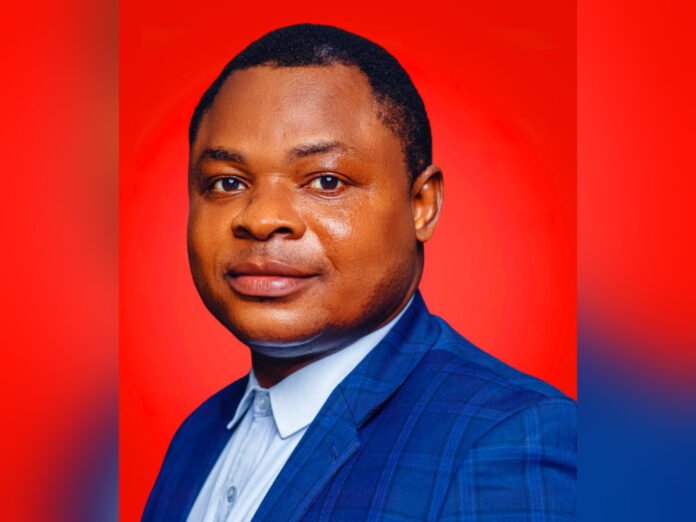
The former Ayawaso Central Constituency Chairman of the NDC, Ebenezer Arkutu has received a groundswell support for the Secretary position in the Greater Accra Region.
Many delegates see his message of institutional reform, grassroots empowerment and people-centred leadership as something that has obviously set him apart.
As the National Democratic Congress (NDC) prepares to elect its Greater Accra Regional executives on Saturday, November 14, Ebenezer Arkutu has made a strong case for his candidacy for Regional Secretary, drawing on his years of grassroots political experience, professional background and an ambitious six-point development agenda.
The former Ayawaso Central Constituency Chairman has distinguished himself in the seven-candidate race with a manifesto that promises to strengthen party structures, improve members’ welfare and establish sustainable sources of funding across the region’s 34 constituencies.
His campaign has also attracted public endorsements and positive assessments from constituency-level party figures, including former Ayawaso East Constituency Secretary Dr Ahmed M. Gedel and the current Ayawaso Central Constituency Secretary Michael Ofosu Semenyhia.
His campaign says the support he has received from constituency executives and other party stakeholders like Members of Parliament reflects growing confidence in his leadership vision as delegates prepare to decide who takes charge of the region’s administration.
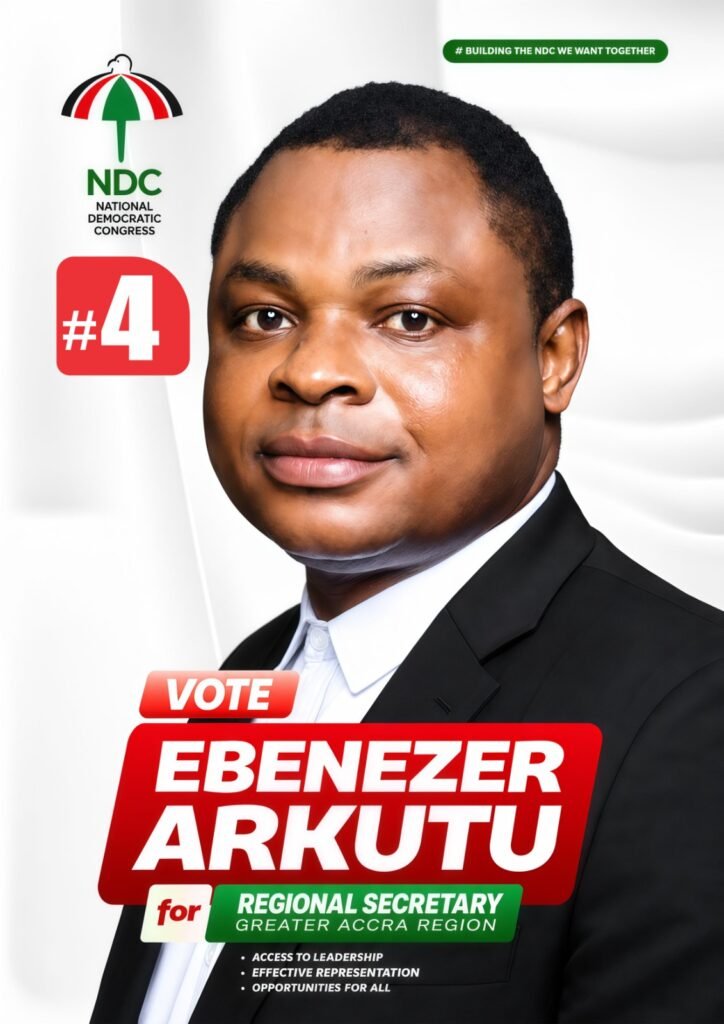
Built around the message “Access to Leadership, Effective Representation and Opportunities for All,” Arkutu’s vision is to create a regional administration that is more efficient, accountable and responsive to the needs of party members.
From grassroots service to regional leadership
Arkutu’s political journey began within the grassroots structures of the NDC in Ayawaso Central, where he developed his political experience and built relationships before rising through the party’s ranks to become Constituency Chairman.
In a profile titled “From the Roots of Service to the Heights of Leadership: The Ebenezer Arkutu Story,” Dr Ahmed M. Gedel describes his political development as an example of leadership built on commitment, perseverance, loyalty and service.
Dr Gedel highlights Arkutu’s emergence as one of the youngest constituency chairmen in the party’s history, arguing that his journey demonstrates the value of youthful leadership grounded in organisational discipline and practical political experience.
He also points to Arkutu’s professional exposure in Ghana’s public and private sectors, particularly his experience in administration and organisational management, as relevant to the demands of the Regional Secretary’s office.
“Ebenezer Arkutu represents that remarkable tradition of political commitment, organizational experience, and institutional loyalty,” Dr Gedel wrote.
He further observes that it is the combination of “grassroots legitimacy, youthful dynamism, administrative experience, institutional knowledge, and organizational maturity” that distinguishes Arkutu’s leadership profile.
Similarly, Ayawaso Central Constituency Secretary Michael Ofosu Semenyhia has described Arkutu as an advocate of people-centred leadership.
Drawing attention to his human resource experience at COCOBOD, Mr Semenyhia emphasises the importance of recognising talent, empowering people, strengthening institutions and creating opportunities.
“A political party’s greatest asset is not merely its structures, but the people who give those structures meaning,” he stated.
“As a seasoned Human Resource Professional at COCOBOD, Ebenezer Arkutu understands that effective leadership begins with recognizing talent, empowering people, building institutions, and creating opportunities,” Mr Semenyhia added.
Six-point agenda offers a roadmap for reform
At the centre of Arkutu’s campaign is a six-point manifesto covering infrastructure, healthcare, education, enterprise development, legal assistance and grassroots communication.
A major priority is the establishment of permanent offices for the regional and constituency structures.
Arkutu pledges that, if elected, he will work towards acquiring land and commencing construction of a permanent Regional Secretariat within 18 months of assuming office.
He also proposes a Constituency Infrastructure Fund to support all 34 constituencies in acquiring or constructing permanent offices. A Corporate Adopt-A-Constituency initiative would further encourage party patrons and corporate stakeholders to support the development of constituency offices.
On healthcare, Arkutu proposes a Regional Health and Medical Aid Fund to assist members facing critical illnesses, surgeries and emergency medical evacuations.
The proposed fund would be supported through a one per cent contribution from the earnings of participating MPs, government appointees and party patrons, alongside voluntary contributions from members.
An annual Health-for-All Gala would also be organised to mobilise additional resources, while an independent board of trustees would oversee the fund to promote transparency and ensure that assistance is distributed according to need.
His education agenda proposes an Educational Affairs and Opportunity Unit, comprising a Scholarship Placement Desk, a Computerised School Selection and Placement System (CSSPS) Support Desk and a Tertiary Admissions Hub.
The proposed structures would help members and their families access local and international scholarship opportunities, navigate senior high school placement challenges and pursue admission into tertiary institutions.
Through these interventions, Arkutu says he wants to replace ad hoc educational assistance with a more coordinated and accessible system that creates opportunities across the region.